
 English - US
 German - Germany
 Italian - Italy
 English - UK
Designing an efficient, safe vehicle workshop requires careful planning of every technical detail.
Among automotive and heavy-duty vehicle maintenance professionals, a common misconception persists, often driven by the desire to reduce initial installation costs: that a single “standard-size” exhaust extraction hose can work equally well for any vehicle, from a small passenger car to a large truck.
This assumption is fundamentally flawed. A one-size-fits-all approach is inefficient and can compromise both operator safety and vehicle protection. In this article, we explain why correctly sized exhaust extraction systems matter and what can go wrong when the equipment is unsuitable.
The serious risks of using a standard 100 mm hose for heavy-duty vehicles
The heavy-duty sector covers the servicing of trucks, agricultural machinery and buses. These vehicles may produce large volumes of exhaust gas at very high temperatures.
Vehicle exhaust emissions contain hazardous substances, including carbon monoxide, unburned hydrocarbons and nitrogen oxides. Rather than allowing these emissions to disperse into the workshop, they must be captured at the tailpipe and safely discharged.
Using a conventional 100 mm diameter flexible extraction hose for these applications can be dangerous. An undersized hose and extraction system can have several serious consequences:
-
Toxic exhaust gas leakage: An insufficient hose diameter can restrict the airflow required to capture the full volume of exhaust gases, allowing hazardous contaminants to escape into the workshop.
-
Heat damage and premature wear: If an exhaust extraction hose is not made from materials rated for the operating temperature, it can deteriorate rapidly, with a risk of melting or fire.
-
Unplanned downtime: Premature equipment failure can interrupt workshop operations and lead to repeated replacement costs for unsuitable components.
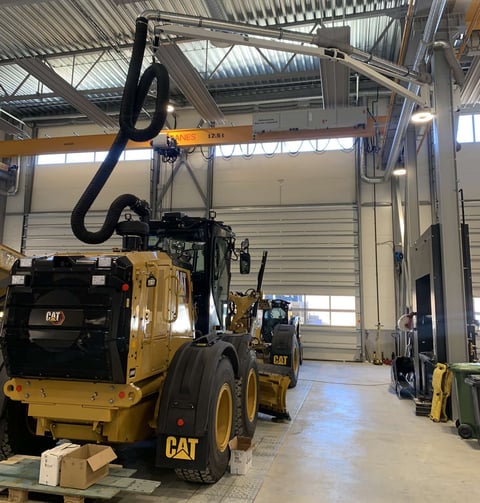
To handle these airflow rates and exhaust temperatures safely, heavy-duty workshops require application-specific solutions, such as high-temperature extraction arms and larger-diameter hoses.
Why an oversized heavy-duty extraction system is inefficient for passenger cars
The opposite mistake is to install an oversized system—for example, with 150 mm or 200 mm ducting—to accommodate occasional heavy-duty vehicles, even though it is used mainly for small passenger cars.
Using heavy-duty extraction components for everyday automotive servicing creates significant practical and financial disadvantages:
-
Excessive energy consumption: Moving much more air than a small car actually requires can unnecessarily increase the electricity needed to run the extraction system.
-
Incompatible exhaust nozzles: Truck exhaust extraction nozzles are often large and rigid. Fitting them to modern vehicles with integrated or recessed tailpipes can be difficult and may prevent a sufficiently secure connection.
-
Risk of bodywork damage: Handling heavy, rigid components close to a passenger car increases the likelihood of accidental scratches or dents to painted surfaces and plastic trim.
Correct system sizing: WORKY solutions for every vehicle category
For effective exhaust extraction, the capture device must be suited to the tailpipe configuration and exhaust gas temperature of the vehicle being serviced. WORKY, an Italian designer and manufacturer of exhaust extraction systems, offers tailored solutions for different workshop applications:
-
Automotive workshops: Lightweight, flexible extraction hoses and exhaust nozzles made with scratch-resistant materials are designed to help protect vehicle bodywork and accommodate delicate bumper-integrated exhaust outlets.
-
Heavy-duty workshops: Self-supporting extraction arms and reinforced components are designed to withstand the demanding temperatures and operating conditions associated with larger vehicles.
Relying on a supposedly universal “standard size” can expose your workshop to unnecessary energy costs and significant day-to-day safety risks.
Choosing a vehicle exhaust extraction system sized to the actual airflow requirements of the vehicles you service can help reduce electricity consumption, protect customers’ vehicles from accidental damage and safeguard your team. For WORKY, engineering tailored solutions that combine safety and energy efficiency is central to its approach.


Contact our specialists for a detailed assessment of your workshop layout and discover how to design a high-performance exhaust extraction system tailored to your operational needs. Request a personalised consultation today.

Frequently asked questions
Why is a standard exhaust extraction hose dangerous for heavy-duty vehicles?
A standard hose diameter, such as 100 mm, may not provide the airflow needed to capture all the exhaust gases generated by trucks, allowing hazardous contaminants to disperse into the workshop. Unless hoses and extraction arms are specifically rated for high exhaust temperatures, they can also deteriorate, melt or present a fire risk.
What are the disadvantages of an oversized exhaust extraction hose for passenger cars?
Heavy-duty ducting and extraction nozzles can result in unnecessary electricity consumption because the system moves more air than a passenger car requires. Oversized nozzles are also bulky and rigid: they can be difficult to connect to integrated tailpipes and may increase the risk of scratching vehicle bodywork.
How do I choose the right vehicle exhaust extraction hose for my workshop?
Select and size the system according to the vehicles you service and their actual extraction requirements. The capture device should suit the shape and temperature of each exhaust outlet. Passenger cars typically benefit from lightweight flexible hoses and scratch-resistant nozzles, while heavy-duty applications may require reinforced components and larger hose diameters.
