
 English - UK
 Italian - Italy
 German - Germany
In enclosed workplaces where motor vehicles are operated, a widespread and dangerous misconception persists: the idea that “if you cannot smell exhaust fumes, the air must be clean”.
This false sense of security can lead workshop professionals to underestimate their daily exposure to potentially toxic exhaust gases, relying on their sense of smell to assess a risk it cannot reliably detect. Modern engines equipped with particulate filters have significantly reduced the black smoke and characteristic odours of older vehicles, but harmful emissions can still be present even when they are less noticeable.
Carbon monoxide: an invisible, odourless hazard
Exhaust emissions from internal combustion engines contain a complex mixture of pollutants, including carbon monoxide (CO), unburned hydrocarbons and nitrogen oxides (NOx). Each can pose health risks, but carbon monoxide is especially deceptive: it is completely odourless, colourless and tasteless.
It can spread through the air without being noticed by human senses. Detecting its presence requires suitable monitoring equipment.
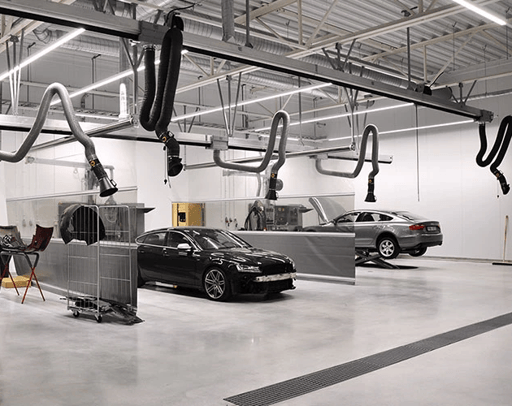
Why your sense of smell can mislead you – and why symptoms come too late
Smell is not a reliable indicator of workshop air quality. Many exhaust pollutants are odourless, while those with a detectable smell can cause “olfactory fatigue”, also known as olfactory adaptation.
In practice:
-
after prolonged exposure to a constant odour, the brain can temporarily stop noticing it;
-
the fact that an unpleasant smell disappears does not mean the air is clean: your sense of smell may simply have adapted.
Physical symptoms can be equally misleading. Headaches, dizziness or nausea may indicate that exposure has already occurred. These are not early preventive warnings: in carbon monoxide poisoning, CO binds to haemoglobin and reduces the blood’s ability to carry oxygen.
Why local exhaust extraction at source matters
It is often assumed that leaving workshop doors or rooflights open is enough to control exhaust fumes. General ventilation alone, however, cannot reliably prevent exposure because:
-
harmful exhaust gases can spread and mix rapidly throughout the workshop air;
-
carbon monoxide has a density close to that of ambient air, so it can disperse throughout the occupied breathing zone rather than simply rising or sinking;
-
once gases have dispersed into the room, removing them becomes more difficult, and they may pass through workers’ breathing zones before reaching an opening.
This is why a fundamental principle of occupational hygiene is to capture vehicle exhaust gases directly at the tailpipe and discharge them safely outdoors before they enter the workshop environment.

WORKY solutions for safe, efficient vehicle exhaust extraction
To make source capture practical in everyday workshop operations, WORKY designs and manufactures Made in Italy vehicle exhaust extraction systems that combine safety, flexibility and efficiency. Its range covers different technical requirements and workshop layouts:
-
Fixed systems (exhaust hose reels): Particularly suitable for smaller workshops, these units neatly store the flexible extraction hose and allow it to be positioned quickly and safely at the vehicle tailpipe.
-
Aluminium extraction rails (GAT): For workshops with multiple service bays, the modular GAT range uses extruded aluminium rails with sliding components, such as trolleys and hose reels. The extraction point can move to the vehicle being serviced.
-
Mobile systems (Grolly): For occasional use or where fixed wall- or ceiling-mounted installations are not feasible, Grolly mobile exhaust extractors offer a flexible alternative. These trolley-mounted units collect exhaust fumes without a permanent extraction installation and discharge them through a dedicated exhaust hose.


Frequently asked questions
Why does a lack of exhaust smell not mean workshop air is clean?
Many components of vehicle exhaust emissions, especially carbon monoxide, are completely odourless, colourless and tasteless. In addition, the sense of smell can rapidly adapt to persistent odours through olfactory fatigue.
What are the early symptoms of carbon monoxide poisoning, and when do they appear?
Common early symptoms include headache, dizziness and nausea. If these symptoms occur, exposure may already be affecting the body’s oxygen supply.
Is opening workshop doors enough to remove exhaust gases?
No. General ventilation alone cannot reliably prevent exhaust gases from spreading throughout the workspace. Capturing emissions directly at the tailpipe, before they reach workers’ breathing zones, is the preferred source-control approach.
Which vehicle exhaust extraction systems does WORKY offer?
WORKY offers solutions for different workshop layouts: compact fixed exhaust hose reels, GAT aluminium extraction rails with sliding components for multiple service bays, and Grolly mobile exhaust extractors for occasional or flexible use.
