
 English - UK
 Italian - Italy
 German - Germany
In automotive repair workshops, bodyshops and heavy-duty vehicle maintenance facilities, indoor air quality is a critical concern. Yet one persistent misconception remains: that vehicle exhaust extraction systems are bulky, difficult to configure and disruptive to everyday workshop operations.
Modern extraction technology tells a different story. The real obstacle to an efficient workflow is not a well-designed extraction system, but the lack of one. Today’s solutions are developed with operator ergonomics in mind, helping to minimise setup time.
WORKY solutions show how an occupational safety requirement can also become an operational advantage.
From Traditional Exhaust Extraction to Modern Workshop Ergonomics
Earlier-generation systems had clear limitations: heavy hoses, hose reels prone to jamming and rigid metal exhaust nozzles that could take valuable minutes to set up.
These drawbacks made exhaust extraction seem like an obstacle to productivity. Today, advances in materials, equipment design and automation have addressed many of these problems. Modern systems can be integrated into workshop layouts, making exhaust extraction faster, simpler and safer as part of the daily workflow.

GTL Touchless Exhaust Extraction Arms: No Direct Tailpipe Connection
One of the main challenges has always been connecting an extraction nozzle directly to a vehicle’s tailpipe. Modern exhaust outlets are increasingly complex: they may be integrated into the bumper, concealed or arranged as dual exhausts.
Touchless technology was developed to simplify this operation. The WORKY GTL universal exhaust extraction arm is a self-supporting articulated arm designed to capture exhaust gases without coming into contact with the vehicle.
How Does the GTL Touchless System Work?
A system of balanced springs and internal mechanical friction joints keeps the arm in position. The operator simply pulls the control cord to position the extraction nozzle behind the exhaust outlet.
Key Benefits of Touchless Exhaust Extraction
-
Time savings: Positioning takes only a few seconds, helping reduce setup time across repeated daily operations.
-
Lower equipment costs: No need to purchase and store numerous rubber or metal tailpipe adapters for different vehicle models.
-
Vehicle protection: Contact-free positioning avoids the risk of scratches caused by the extraction nozzle on carbon-fibre bumpers or chrome exhaust tips—particularly valuable when working on premium vehicles.
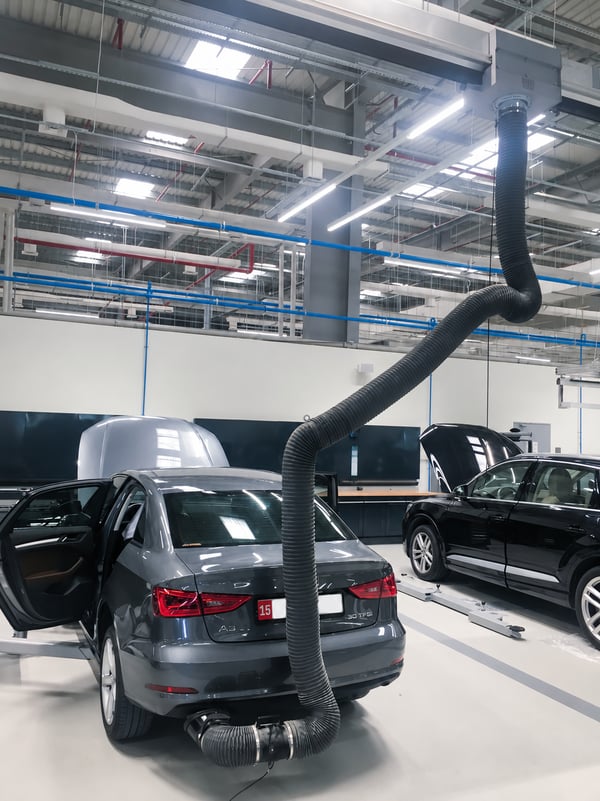
Flexible Workshop Exhaust Extraction: Sliding Rails and Crush-Resistant Hoses
Flexibility is another key feature of modern systems. Instead of adapting workshop operations to the extraction equipment, the equipment can be configured around the way the workshop works.
-
Sliding rail systems (WORKY GAT series): Extruded aluminium extraction rails allow moving extraction units, such as articulated arms or exhaust hose reels, to serve multiple work bays and follow vehicles between working positions.
-
Crush-resistant flexible hoses (WORKY GT2 series): A reinforcing nylon spiral helps the hose withstand accidental compression and recover its original shape, reducing problems caused by hoses being stepped on or driven over.
Automation, Occupational Safety and Regulatory Compliance
Automation further reduces day-to-day handling. With integrated control systems and microswitches on hose reels, unreeling a hose can automatically start the extraction fan. A timer can then switch it off, simplifying operation and helping prevent unnecessary electricity consumption.
Regulatory requirements are also important. In Italy, Legislative Decree 81/2008 establishes occupational health and safety duties, including control of hazardous airborne substances at source where applicable. Opening workshop doors alone should not be treated as a substitute for an appropriately designed source-capture exhaust extraction system. Specific obligations and enforcement consequences depend on the working conditions and applicable legislation.
Conclusion: Exhaust Extraction Can Improve Workshop Efficiency
The idea that vehicle exhaust extraction must be cumbersome belongs to an earlier generation of equipment. Touchless solutions and automated systems help protect technicians while streamlining everyday tasks—bringing safety and productivity together.

Frequently Asked Questions
How does a GTL Touchless extraction arm work without touching the tailpipe?
The self-supporting design of WORKY GTL Touchless arms allows operators to position the extraction nozzle behind the vehicle’s exhaust outlet. No direct attachment to the tailpipe is required, and the arm maintains the selected working position.
Can a Touchless exhaust extraction system scratch a supercar’s bumper?
Because the nozzle does not need to touch the vehicle, a correctly positioned Touchless system avoids scratches caused by nozzle contact with carbon-fibre bumpers, delicate paintwork or chrome exhaust tips.
Is opening workshop doors enough to remove vehicle exhaust gases?
No. Natural ventilation alone does not provide the same control as capturing exhaust emissions close to their source. In Italy, the occupational safety framework under Legislative Decree 81/2008 requires appropriate measures to control hazardous exposure; the actual solution must be selected for the workshop and its activities.
